
.png)
A Practical Guide to Stakeholder Management in Projects

When we talk about stakeholder management, we're really talking about the process of figuring out who has a skin in the game, listening to what they need, and keeping them in the loop. It’s a game plan for making sure everyone's expectations are clear and managed from the get-go. In today's messy project environments, it's not just a nice-to-have; it's a must-have for getting anything meaningful done.
Why Stakeholder Management Is Your Project's Lifeline
Picture your project as a ship trying to cross a massive ocean. You, the project manager, are the captain. But it's your stakeholders who are the winds, the currents, and even the crew that helps you steer. Thinking about stakeholder management as just another box to check is a huge mistake—it's honestly the single biggest factor that will determine if your project survives the journey.
Let me break it down:
Engaged investors are the fuel in your engine. They provide the resources you need to actually go the distance.
Supportive executives act like a strong tailwind, clearing away those annoying organizational roadblocks and pushing you forward.
Aligned end-users are your North Star. They're the destination, making sure the thing you're building actually solves a real-world problem.
When all these forces are pulling in the same direction, your ship sails smoothly. But when they're not? You’re heading straight into a storm of scope creep, blown deadlines, and busted budgets.
The Real Cost of Misalignment
The fallout from ignoring what your stakeholders need isn't just a hypothetical problem. The data is pretty sobering.
Let's look at the hard numbers. The table below shows just how badly things can go wrong when stakeholders aren't on the same page.
The High Cost of Poor Stakeholder Alignment
Problem Area | Impact Statistic | Primary Cause |
|---|---|---|
Outright Project Failure | 44% of projects fail | Lack of alignment between business goals and project execution |
Lack of Engagement | 78% of teams feel business stakeholders aren't engaged enough | Insufficient communication and involvement from leadership |
Senior Leadership Gaps | 33% of projects collapse | Senior management is absent or disengaged |
These statistics, drawn from studies by PMI and Geneca, aren't just numbers—they represent real projects, real money, and real frustration. They paint a clear picture: if you don’t get proactive about engaging people right from the kickoff, you’re basically sailing blind.
Stakeholder management is the art of turning potential project adversaries into your most valuable advocates. It transforms passive observers into active partners who not only support your vision but help you navigate around obstacles.
From Theory to Practical Application
So, what does this actually look like day-to-day? It's a lot more than just blasting out a weekly email update. It means you have to systematically figure out who cares about your project, understand what drives them, and then build a communication plan that keeps them involved just the right amount.
Think about it like a home renovation. In any of the 5 steps during a remodeling project, constant, clear communication with the homeowners, contractors, and suppliers is absolutely critical to avoid disaster. Your project is no different.
This structured approach is your project's true lifeline. It provides the stability and direction you need to not just stay afloat, but to actually reach your destination successfully.
Identifying and Mapping Your Project Stakeholders
Before you can steer your project ship through open waters, you need a reliable map. That’s exactly what identifying and mapping your stakeholders is—it turns a sea of faces into a clear guide for who to talk to, when, and how. Skip this, and you're flying blind.
The first job is simple but absolutely critical: figure out everyone who has a stake in your project's outcome. And I don’t just mean the obvious players. You need to look both inside and outside your organization to get the full picture.
Uncovering Your Stakeholders
Start by casting a wide net. Honestly, a good old-fashioned brainstorming session with your core team is the best way to kick this off. The goal is to list every single person, group, or department that could be influenced by—or have an influence on—the project.
To make sure you don't miss anyone, think in two broad categories:
Internal Stakeholders: These are the folks inside your organization. We're talking about your project team, department heads, IT, legal, and of course, the C-suite. They're directly invested in how the project runs and whether it succeeds.
External Stakeholders: These are all the people and groups outside your company walls. This could be your clients, end-users, suppliers, regulatory bodies, or even the local community. Don’t underestimate them; their influence can be just as powerful.
This diagram shows how different stakeholders—like investors, execs, and users—are all essential inputs throughout a project's life.
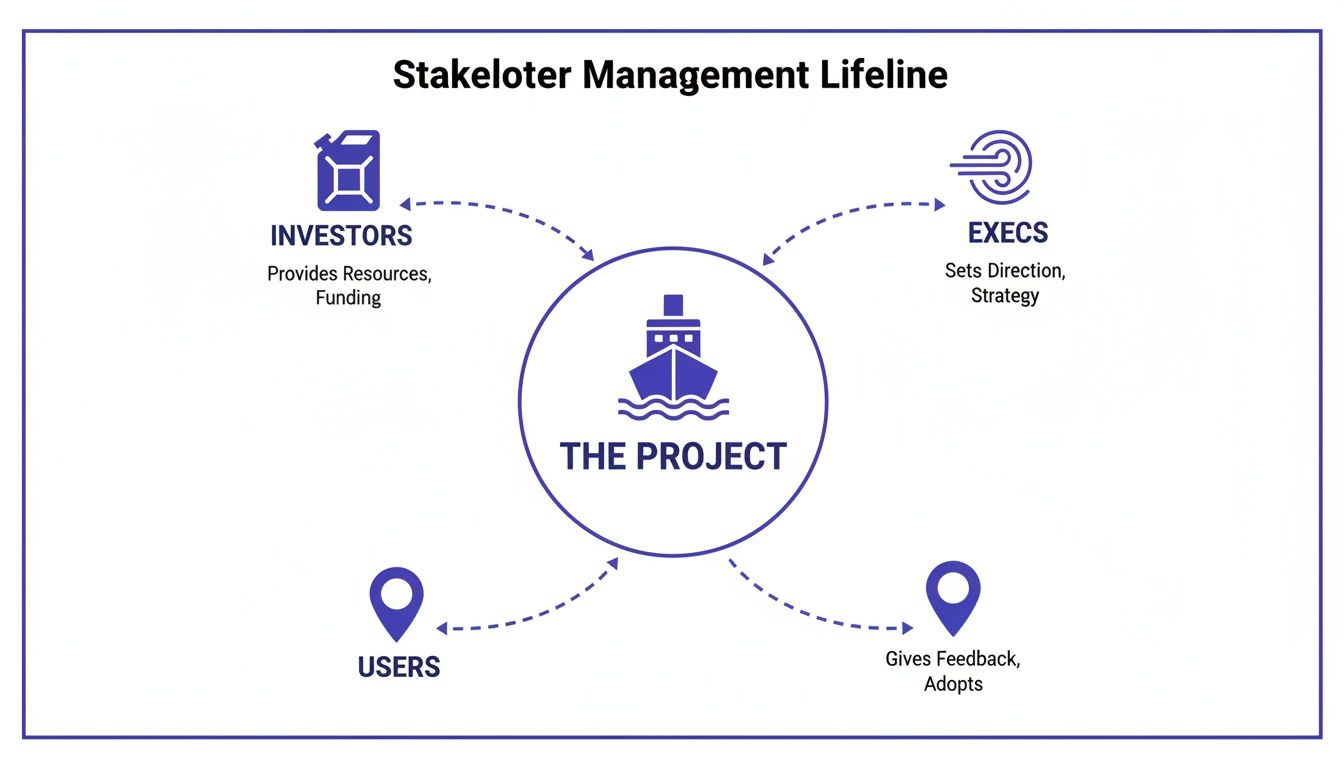
The real insight here is that each group brings something different but vital to the table, whether it’s funding, strategic direction, or just telling you if the thing you're building is actually useful.
Prioritizing with the Power and Interest Grid
Once you have your big list, you’ll realize pretty quickly that you can’t treat everyone the same. Trying to is a surefire way to burn yourself out and communicate poorly. This is where stakeholder analysis comes in, and a brilliantly simple tool called the Power/Interest Grid is perfect for the job.
This framework helps you sort everyone by plotting them against two key factors: their level of power (how much they can influence the project) and their level of interest (how much the outcome affects them).
By mapping your stakeholders, you transform a long list of names into an actionable engagement strategy. You’re not just identifying people; you're understanding their roles and defining how to interact with them effectively.
This process sorts your stakeholders into four quadrants, each with a clear game plan:
Manage Closely (High Power, High Interest): These are your key players. Your project sponsor, your primary client—the people you need to keep happy at all costs. Engage them fully and make them your top priority.
Keep Satisfied (High Power, Low Interest): This group has the clout to shut you down but isn't wrapped up in the daily grind. Think of a company CEO or a regulatory agency. Give them just enough information to keep them satisfied, but don't bog them down with details they don't care about.
Keep Informed (Low Power, High Interest): These are people like the end-users of a new software feature. They care a lot about the outcome but have very little direct say. Keep them in the loop with regular, clear communication to make sure no major issues pop up.
Monitor (Low Power, Low Interest): This group needs the least amount of your energy. Just keep an eye on them in case their power or interest level changes, but don't flood their inboxes with updates.
Let's say you're leading a website redesign. Your CEO (Keep Satisfied) needs the 30,000-foot view on how the project is hitting business goals, not a daily bug report. Meanwhile, the customer support team (Keep Informed) desperately needs to know about upcoming changes that will impact their daily workflow. A simple map like this makes sure your communication always hits the mark.
Building Your Stakeholder Communication Playbook
Alright, so you’ve mapped your stakeholders. You know who they are and why they matter. Now for the fun part: figuring out how to talk to them. This is where you build your communication playbook.
And let's be clear, this isn't about blasting out a generic weekly email and calling it a day. It's about creating a deliberate, thoughtful rhythm of communication that builds trust, shapes perceptions, and keeps everyone genuinely pulling in the same direction. Solid stakeholder management hinges on moving from just reacting with updates to leading with a strategic plan.
Think of it like this: your stakeholder map is the architectural blueprint of a house. It shows you where all the rooms are. Your communication playbook? That’s the electrical wiring plan. It dictates exactly how information flows to each room, making sure the right places get the right amount of power at the right time. Without it, you’re just asking for blackouts and confusion.
The big idea here is to tailor everything—your style, your timing, and your channels—to each specific group you identified on your Power/Interest Grid. One size absolutely does not fit all.
Customizing Your Communication Channels
Let's start with your high-power, high-interest folks—the ones you need to "Manage Closely." These people require a high-touch, personal approach. Trust me, flooding their inbox with generic project updates is the fastest way to get ignored. Your playbook needs to outline dedicated channels just for them.
A few strategies that work wonders:
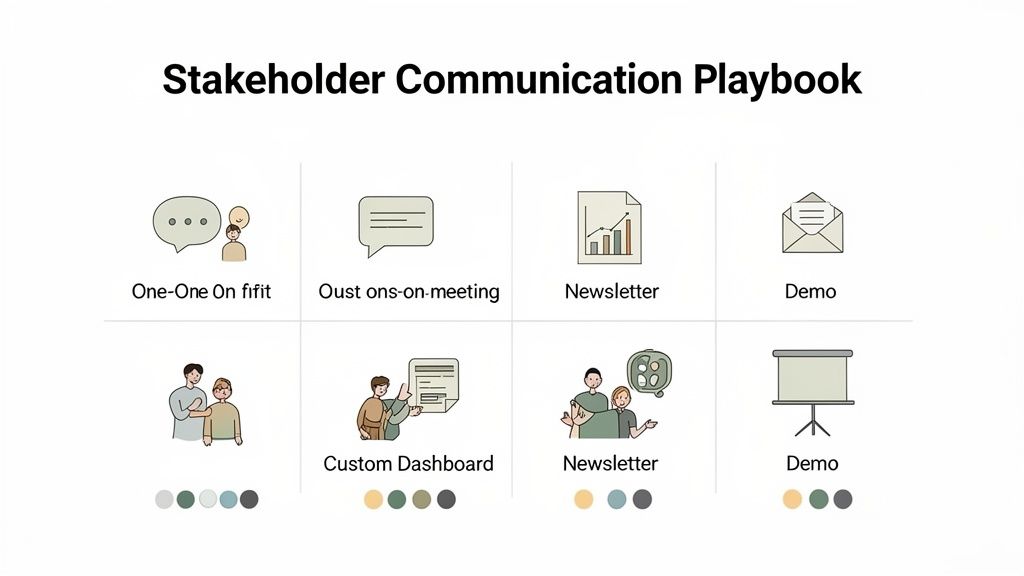
Dedicated One-on-One Meetings: A bi-weekly 30-minute sync with your project sponsor is worth more than a dozen emails. It's your space for real, unfiltered feedback and making sure you're still aligned on the big picture.
Custom Dashboards: Give them a real-time window into the metrics they actually care about, like budget burn or milestone progress. It shows you respect their time and gives them the confidence to let you work.
Direct Slack Channels: For anything urgent, a private channel cuts through all the corporate noise and lets you get quick decisions when you need them most.
Now, for the stakeholders in the "Keep Informed" box, like your end-users. They need clear, consistent updates, but they don't need to be in the weeds with you. For them, your playbook might call for a different set of tactics: maybe a monthly newsletter, team-wide demos of new features, or a quick shout-out in the company town hall. The trick is always matching the method to their needs.
Designing Your Communication Matrix
To make all of this official, a simple communication matrix is your best friend. It’s just a straightforward table that documents your entire strategy so nothing falls through the cracks. It takes all those good ideas about stakeholder management in projects and turns them into a concrete, actionable plan.
For each stakeholder group, your matrix should nail down four key questions:
Who are you talking to? (e.g., Project Sponsor, Executive Team)
What do they need to know? (e.g., Budget status, risk assessment, key decisions needed)
How are you going to tell them? (e.g., In-person meeting, email summary, dashboard)
When are you going to deliver it? (e.g., Weekly, monthly, at each milestone)
Here's a simple look at what that might be:
Stakeholder Group | Information Needed | Communication Channel | Frequency |
|---|---|---|---|
Executive Sponsor | Budget status, major risks, decisions required | 1-on-1 Meeting & Dashboard | Weekly |
Marketing Team | Go-live dates, feature updates for campaigns | Project Newsletter & Team Demo | Bi-weekly |
End-Users | Upcoming changes, training guides | Company-wide Email | Monthly |
A well-defined communication playbook shifts your role from a project reporter to a project leader. You control the narrative, prevent surprises, and turn stakeholders into genuine partners who feel heard, respected, and part of the journey.
I know this level of planning can feel like overkill at first, but the payoff is huge. Research from the Project Management Institute (PMI) backs this up: organizations that communicate effectively complete 80% of their projects on time and on budget. For those who don't prioritize it? That number drops to just 52%.
Building your own plan doesn't have to be a massive undertaking. To get a head start, you can grab a proven framework from our guide on a project communication plan template that actually works. Think of this plan as the rudder for your project—it’s what will keep you sailing smoothly and ensure every single stakeholder has the right info to help you get to a successful launch.
Mastering Engagement and Managing Expectations
Alright, you've got your stakeholder map and a communication playbook ready to go. Now it's time to roll up your sleeves and shift from planning to practice. This is where the real magic of stakeholder management in projects happens—actively engaging with people, building trust, and skillfully managing their expectations.
It’s a hands-on process of running meetings that actually go somewhere, getting feedback that's genuinely useful, and handling those tricky conversations with confidence.
Believe me, the difference between a project that flies and one that flops almost always comes down to this active engagement. The data doesn't lie: projects with highly engaged stakeholders see a massive 78% success rate, while those with low involvement barely scrape by at 40%. Yet, so many projects get derailed by simple misunderstandings that spiral into major conflicts.
When you nail this, stakeholders stop being passive spectators and turn into your project’s biggest champions. People who feel heard and valued will go out of their way to clear roadblocks and advocate for your goals, helping you get across the finish line.
Leading Meetings That Drive Decisions
We've all been there—the meeting that could have been an email. They're absolute project killers. Your goal isn't just to share information; it's to run sessions that lead to concrete decisions and clear next steps. Vague agendas and rambling chats waste everyone's time and chip away at their confidence in you.
To make every meeting count, you need a solid game plan.
Define a Crystal-Clear Purpose: Every single meeting invite should answer the question, "By the end of this, what decision will we have made?" If you can't answer that, it really should be an email.
Send Materials Ahead of Time: Give everyone a fighting chance to contribute. Send out any docs, data, or proposals at least 24 hours in advance. This lets your key players show up ready to talk specifics, not just see the info for the first time.
Facilitate, Don't Dominate: As the project manager, you're the guide, not the star of the show. Your job is to steer the conversation, make sure everyone gets a word in (especially the quiet ones), and keep the discussion on track.
Recap and Assign Next Steps: Never end a meeting without summarizing the decisions made, who's responsible for what, and when it's due. This one simple habit kills ambiguity and builds accountability.
Following this structure shows you respect everyone's time. It turns each meeting into a productive step forward and builds real momentum.
True stakeholder engagement isn't about constant communication; it's about consistent, purposeful communication. It's the art of making every interaction meaningful, ensuring stakeholders feel like valued partners, not just an audience.
Handling Scope Creep and New Requests
Ah, the dreaded "last-minute request" from a key stakeholder. This is one of the toughest challenges you’ll face. Picture this: your team is weeks from launching a new app, and a senior exec suddenly wants a brand-new feature. Saying a flat "no" could burn a critical bridge, but a "yes" could blow up your timeline.
This is where your stakeholder management skills are truly tested. Instead of panicking, you need a calm, methodical way to handle scope creep without creating a crisis. If you want to dive deeper, we've got a whole guide on top stakeholder engagement strategies for project success.
Here's a simple framework for navigating these requests:
Acknowledge and Appreciate: First things first, thank them for the idea. Something like, "That's a great suggestion, thanks for bringing it up. Let's dig into what it would take to make that happen," shows you're listening without instantly committing.
Assess the Impact: Take the request back to your team for a quick but thorough analysis. What's the real cost in time, money, and resources? What other priorities would have to get bumped to make room for this?
Communicate the Trade-Offs: Circle back with the stakeholder to present your findings. Don't just give them a number; frame it as a set of choices. "We can absolutely build this feature, but it will delay our launch by three weeks and add $15,000 to the budget. Another option is to add it to the roadmap for the Q3 release."
Document the Decision: Whatever you decide, write it down and share it with everyone involved. If the new feature gets the green light, update your project plan, budget, and timeline. If they decide to wait, make sure it's logged in the project backlog for future consideration.
This transparent approach turns a potentially tense standoff into a collaborative decision. You're no longer just a gatekeeper—you’re a strategic partner helping them balance their vision with the project's reality.
How Modern Tools Transform Stakeholder Feedback
Let's be honest. In any project, especially with fast-moving or remote teams, the feedback process can turn into a nightmare. You know the drill: endless, confusing email chains and vague comments like "the button looks weird" bring everything to a screeching halt. It’s frustrating for everyone. This is exactly where modern stakeholder management tools come in, completely changing the game.
Instead of wrestling with clunky, manual methods, these platforms offer a central, visual hub to gather and manage feedback. They're designed to kill ambiguity, turning subjective opinions into crystal-clear, actionable tasks that developers and designers can jump on right away. This isn't just a small improvement; it's a fundamental shift in how projects get done.
From Vague Comments to Actionable Tasks
The single biggest problem with old-school feedback is the missing context. A stakeholder might email you about an issue, but without seeing what they see, your developers are just left guessing. What browser were they using? Which operating system? What specific page were they even looking at?
This is where visual feedback tools like Beep make a massive difference. Picture this: a stakeholder is reviewing a new landing page. Instead of drafting an email, they just click on the element that’s bothering them and type their comment right there on the live page. Simple.
But here’s the magic. The tool automatically grabs all the critical info with every single comment:
A screenshot of the exact part of the page they're talking about.
Browser and OS data to help your team replicate any bugs.
Console logs that give developers the deep technical details they need.
Suddenly, a comment like "the form isn't working" transforms into a complete bug report that a developer can solve in minutes, not hours. It completely closes the gap between what the stakeholder sees and what the project team needs to fix it.
Increasing Transparency with Real Time Visibility
Another huge source of friction in stakeholder management is the feeling of being in the dark. After sending feedback, stakeholders often feel like their comments just disappeared into a black hole. They have no clue if their input was received, understood, or when it might get addressed. That uncertainty slowly eats away at trust and leads to constant, annoying follow-ups.
To fix this, modern platforms build project management features right into the feedback loop. Many tools, Beep included, use an integrated Kanban board where every piece of feedback automatically becomes a task card.
This gives stakeholders a live view of where their feedback stands. They can see at a glance if a task is:
To Do: Yep, we got it. It's in the queue.
In Progress: Someone is actively working on it right now.
Done: The change is live and ready for you to check out.
This level of transparency is a game-changer for building strong stakeholder relationships. It shows them their feedback is valued and being acted on, which fosters a genuine sense of partnership and trust.
This screenshot gives you an idea of how a tool like Beep can plug right into your workflow, connecting stakeholder feedback from the front end to your project management systems like Slack or Jira.
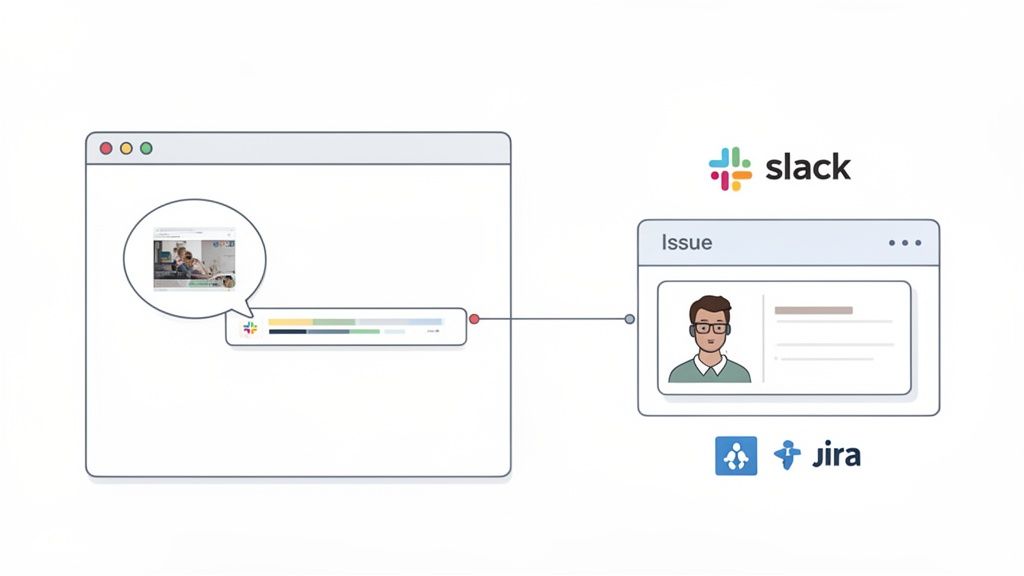
The key takeaway here is that automation gets rid of the soul-crushing manual work of copying feedback from one system to another. Nothing gets lost in translation. If you're looking to really dial in your own process, exploring different user feedback tools is key to maximizing your business growth.
Seamless Integration with Your Existing Workflow
The absolute last thing your team needs is another disconnected tool to juggle. The best feedback platforms get this, and they’re built to plug directly into the systems your team already lives in every day.
By connecting with tools like Jira, Slack, Notion, or Zapier, you can create a smooth, automated workflow. For instance, a new comment from a stakeholder in Beep can instantly create a ticket in Jira, assign it to the right developer, and pop a notification into a dedicated Slack channel. For teams in the Web3 space, engaging your community is everything, as this guide on Your Guide to Web3 Community Building That Actually Works explains.
This kind of integration makes sure feedback is handled efficiently, without anyone having to manually copy and paste information between apps. It keeps the whole team on the same page, slashes the risk of human error, and lets everyone focus on what they do best. By weaving feedback directly into the development lifecycle, these tools make stakeholder management a core part of the project, not just an afterthought.
Adapting Your Strategy as Your Project Evolves
Let’s be real: stakeholder management isn’t a “set it and forget it” kind of deal. Projects are messy, living things that twist and turn when you least expect it. The killer strategy you drafted at kickoff could be totally useless by the time you hit the halfway mark.
This is where great project leaders shine. They treat their stakeholder management plan less like a stone tablet and more like a living, breathing guide.
The whole game is about constantly checking the pulse of your stakeholder relationships and being ready to pivot. A stakeholder who was just a casual observer last month could suddenly become the key decision-maker tomorrow thanks to a re-org. If you're not paying attention, you'll miss the shift.
Gauging Stakeholder Sentiment
You absolutely need a way to know how your stakeholders are really feeling. Waiting for a five-alarm fire to erupt is way too late. The good news is you can keep tabs on things with some simple, non-annoying methods.
Think about using a mix of these tactics:
Simple Surveys: Short, snappy pulse surveys with just a couple of questions can tell you a lot without driving everyone crazy with "just one more survey."
Participation Tracking: Are the key players actually showing up to important meetings? When they're there, are they leaning in and contributing, or are they just a face on the screen?
Feedback Analysis: Take a hard look at the feedback you're getting. Is it thoughtful and on time, or are you getting one-word answers a week late?
These aren't just checkboxes; they're your early-warning system. They help you spot a dip in engagement long before it blows up your project.
Spotting the Early Warning Signs
Disengagement almost never happens overnight. It starts with tiny, subtle shifts in behavior that are super easy to miss if you're not looking closely. Learning to spot these tells is a massive skill in project management.
Keep an eye out for these classic red flags:
Meetings get consistently missed or canceled at the last minute.
Approvals start dragging, and responses to important emails slow to a crawl.
They start sending junior team members to make decisions in their place.
You notice they've stopped asking questions or offering any real input.
Your stakeholder map isn't a historical artifact to be filed away; it's a live dashboard. Dusting it off and updating it regularly means your engagement strategy actually keeps up with your project's reality.
When you see these signs, it's time to step in. A quick, one-on-one chat can work wonders. Maybe their priorities got shuffled, or maybe they feel like their feedback is just going into a black hole. A direct, human check-in can bring a wandering stakeholder back into the fold and remind them just how crucial they are to getting this thing across the finish line.
Got Questions? We've Got Answers
Diving into stakeholder management can definitely bring up a few questions. It’s a nuanced part of any project, after all. Here are some of the most common ones we hear, with straightforward answers to help you get it right.
What Is the Difference Between a Stakeholder and a Shareholder?
Ah, the classic mix-up! It's easy to see why, but the difference is pretty huge.
Think of a shareholder as someone who literally owns a share of a public company. They've bought stock, so their main interest is almost always financial—they want to see that stock price go up. Simple enough.
A stakeholder, on the other hand, is a much bigger umbrella. It’s anyone—and I mean anyone—who has a vested interest in your project's outcome. This could be your employees, your customers, the suppliers you depend on, or even the local community affected by your work. They don't have to own a single share to have a stake in what you're doing.
How Do You Handle a Difficult or Resistant Stakeholder?
We've all been there. The key is to start with a little empathy. Before you do anything else, pull them aside for a one-on-one chat. Your goal isn't to convince them of anything just yet; it's to genuinely listen and understand where they're coming from. Let them voice their concerns, and show them you're hearing them.
Once you have their perspective, go back to your stakeholder map. Where do they fit? What’s their real influence and what are their underlying interests? From there, you can start looking for common ground. Frame the conversation around how the project’s success can actually help them achieve their own goals. You're trying to build a bridge, not win a fight.
The real secret to managing a tough stakeholder is turning a confrontation into a collaboration. When you dig into their motivations, you can reframe the entire discussion around shared goals and maybe even turn your biggest critic into a powerful ally.
How Often Should I Update My Stakeholder Analysis?
Great question. Your stakeholder map isn't something you create once and then frame on the wall—it's a living, breathing document.
A good rule of thumb is to give it a fresh look at every major project milestone. Just finished the design phase? Time for a quick review.
You’ll also want to update it immediately if anything significant changes, like a shift in the project’s scope, a new timeline, or a key person leaving the team. For those longer, marathon projects, a quick check-in every quarter is a smart move to make sure your strategy is still on point.
Ready to finally get your feedback process under control and keep every stakeholder in the loop? With Beep, you can turn messy comments into clear, actionable tasks. No more endless email threads, just real-time visibility for everyone. Get started with Beep for free.
Comments