
.png)
How to Improve Collaboration Skills for Better Teamwork

To get better at working together, you really need to nail three things: communicating clearly, handling feedback well (both giving and getting it), and creating a space where people feel safe to speak up. Getting these right changes everything, turning a bunch of individual efforts into a real team win.
Why Great Collaboration Is No Longer Optional

Let's face it, the way we work has completely flipped. The days of everyone staying in their own lane are long gone. Today, it’s all about dynamic, interconnected teamwork, especially with remote and hybrid work being the new normal. You just can’t wing it anymore.
When collaboration breaks down, you feel it. It’s the top reason for missed deadlines, sinking team morale, and those endless meetings that go nowhere and suck the life out of everyone. A lot of teams think the answer is just more meetings, but that usually makes things worse.
The Problem with More Meetings
Here's a wild stat: weekly meeting time has shot up by a massive 252% since early 2020. But even with all that extra screen time, people are checking out. Only 21% of employees feel engaged at work, and a mere 28% feel like their opinions actually matter. That gap tells you everything—more time together doesn't mean better collaboration.
True collaboration isn't about how many hours you spend in meetings. It’s about the quality of those interactions. It takes real, intentional effort to build the skills for communication that’s both purposeful and inclusive.
Setting the Stage for Success
Learning how to collaborate effectively isn't just a "soft skill" anymore; it's a must-have for any professional. It’s how you drive real results, build a culture that can handle anything, and get a serious leg up on the competition. To get there, you need to understand the core principles and effective teamwork strategies that make great teams tick.
This guide isn’t about fuzzy, generic advice. It's a practical roadmap to building these essential skills.
To get us started, here’s a quick look at the key areas this guide will cover, providing a roadmap to a stronger collaboration skillset.
The Core Pillars of Effective Collaboration
Pillar | What It Solves |
|---|---|
Communication Techniques | Fosters clarity and psychological safety. |
Actionable Feedback | Builds rituals that encourage growth, not criticism. |
Remote Collaboration | Masters practices that bridge physical distance. |
Measurement & Iteration | Continuously refines your team's collaborative health. |
We'll dive into each of these, giving you the tools you need to make a real difference in how your team works together.
Foster Psychological Safety with Clear Communication
Let's get one thing straight: true collaboration isn't just about sharing a Google Doc or hopping on the same Zoom call. The real magic happens when people feel safe enough to speak their minds, and that all comes down to how we talk to each other.
If communication is fuzzy or creates fear, even the smartest team on the planet will stumble. Building psychological safety—that feeling of being able to take risks and be vulnerable without getting punished for it—starts with being incredibly deliberate about clear and empathetic communication.
This isn't some fluffy HR concept; it's the bedrock of high-performing teams. When people feel safe, they’ll actually flag a potential issue before it blows up. They’ll toss out that half-baked idea that might just be a breakthrough. They'll admit a mistake without fearing a public takedown. This is what turns a group of talented individuals into a real, problem-solving unit.
Ditch Ambiguity with Structured Communication
Ambiguity is the silent killer of teamwork. Vague instructions, unclear feedback, and wild assumptions lead to so much wasted time and frustration. One of the best things you can do to sharpen your team's collaboration skills is to adopt frameworks that force everyone to be crystal clear.
A great one to start with is the Situation-Behavior-Impact (SBI) model. It's perfect for giving feedback or raising a concern because it strips out all the emotional, subjective language and sticks to the facts.
Situation: "During this morning's client call..."
Behavior: "...you shared the new project mockups before we had the final stats locked in."
Impact: "...which seemed to confuse the client about our final direction and meant we had to schedule a follow-up."
See how that works? It’s not about pointing fingers. Instead, it creates a shared, objective picture of what happened and why it mattered. From there, you can have a productive chat about how to handle it differently next time. It’s a small shift that makes tough conversations feel less personal and way more solution-focused.
Master Active Listening to Build Real Trust
So often, we listen just waiting for our turn to talk. It's a natural habit, but it's terrible for building trust and makes people feel completely ignored. Active listening is a skill, and one of my favorite techniques for practicing it is called "looping."
Before you jump in with your own two cents, you run through three quick steps:
Paraphrase: Restate what they said, but in your own words. "Okay, so what I'm hearing is you're concerned the timeline for the design phase is too aggressive."
Confirm Understanding: Ask if you got it right. "Is that accurate?"
Acknowledge Their Viewpoint: Show them you respect their perspective, even if you don't agree. "That's a valid concern, thanks for raising it."
This simple process forces you to slow down and actually process what your colleague is trying to tell you. It nips misunderstandings in the bud and sends a powerful signal of respect—which is absolutely essential for the kind of trust great collaboration is built on.
When you make someone feel truly heard and understood, you're not just exchanging information—you're building a foundation of psychological safety. This is where innovation and honest collaboration begin to thrive.
How to Disagree Without Being Disagreeable
Disagreements aren't just going to happen; they need to happen for good ideas to surface. A team that avoids all conflict isn't collaborative; they're just overly polite. The trick is to learn how to disagree productively, without torching relationships.
Imagine two developers arguing over the best technical approach for a new feature. Instead of it becoming a battle of egos, a collaborative team finds a way to frame it around a shared goal.
Scenario A (Poor Collaboration):
Dev 1: "Your approach is way too complex and will be a nightmare to maintain."
Dev 2: "Well, your idea is outdated and won't scale when we get more traffic."
Scenario B (Productive Collaboration):
Dev 1: "I'm concerned that this approach might create some long-term maintenance challenges. Can we walk through how we'd handle future updates?"
Dev 2: "That's a fair point. I was prioritizing for the scalability we're expecting. Let's figure out a solution that gives us both maintainability and performance."
The difference is night and day. Scenario B frames the conflict around the problem (maintainability vs. scalability), not the people. By focusing on shared goals and using "I" statements, they can explore a solution together. This turns what could have been a nasty conflict into a powerful problem-solving session that makes both the project and the team stronger.
Master the Art of Actionable Feedback
Let's be real: feedback is the fuel for growth, but it's often the biggest source of friction on a team. When it’s done poorly, it feels personal, makes people defensive, and just shuts down communication. But when you get it right? It becomes an incredible tool that helps everyone improve and, ultimately, produce better work.
The goal is to build a culture where feedback is seen as supportive, not critical. It should be a regular, low-key part of the process, not a dreaded annual review. This means ditching vague comments and creating structured rituals that actually encourage continuous improvement.
From Vague Comments to Clear Actions
Think about the last time someone told you a design "needs more polish" or to "make it pop." What did you do? My guess is you probably wasted hours trying to figure out what they actually meant. That kind of ambiguity is a momentum-killer.
Actionable feedback, on the other hand, is specific, objective, and tied directly to the work itself. It gives you a clear path forward. To make this shift, you don't need a huge overhaul—just a few simple, practical rituals.
Wins and Learns Sessions: At the end of a project or sprint, get everyone together for a quick chat about what went well (wins) and what could be improved (learns). This frames improvement as a shared goal, not an individual failure. It's a game-changer.
Structured Peer Reviews: Create a simple template for peer feedback that forces specificity. Instead of asking, "what do you think?", try asking, "What is the clearest part of this proposal?" and "Where did you feel the most confused?"
If you're looking to go even deeper on creating a feedback-rich environment, check out a complete guide to employee feedback, including examples and tips.
Transform Your Review Cycle with Visual Context
One of the biggest breakthroughs I’ve seen in delivering truly actionable feedback is the move to visual workflows. Let’s face it, written comments in a long email or a dense document are so easy to misinterpret because they lack context. You're left trying to connect a line of text to a specific element on a complex design or webpage. It’s a recipe for frustration.
This infographic breaks down a simple three-step process—Listen, Frame, Share—that fosters the psychological safety needed for feedback to actually land well.
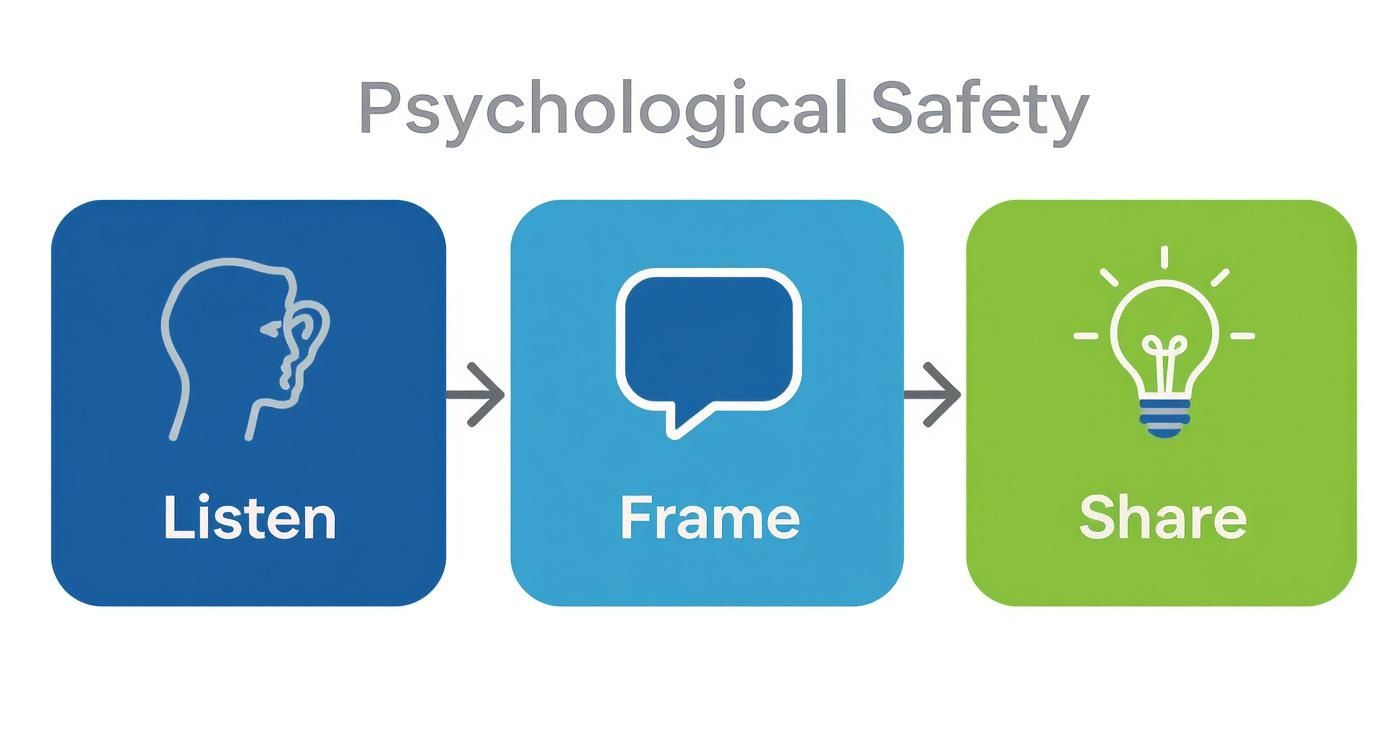
As you can see, great feedback isn't just about talking; it starts with understanding, is delivered with care, and results in a shared insight.
This is where tools that enable visual feedback completely change the dynamic. For example, a platform like Beep lets you leave comments directly on a live website or design mockup. Each piece of feedback automatically captures a screenshot, showing your team exactly what you're talking about.
This simple feature removes all the guesswork. A designer sees the exact button you think is too small. A copywriter sees the precise headline you believe is confusing. This level of specificity makes feedback less personal and infinitely more actionable. You can even use screen recordings to walk through a user flow and explain your thoughts, adding another layer of clarity that text alone just can't match.
When you tie feedback directly to a visual element, you eliminate ambiguity. The conversation shifts from "I don't like it" to "Here's why this specific part isn't working, and here's what we could do instead."
Making Feedback a Continuous Loop
Ultimately, the key to leveling up your team's collaboration skills is turning feedback into a continuous, low-friction loop. It shouldn't be some monumental event, but rather a series of small, helpful adjustments that happen all the time.
By combining structured rituals with context-rich visual tools, you create an environment where feedback is genuinely welcomed. It becomes a tool for alignment, not a source of conflict. This helps teams iterate faster, learn from mistakes without blame, and build a real sense of collective ownership over the final product.
For more hands-on guidance, check out these 7 actionable feedback examples to improve performance that you can start using today.
Build a Tech Stack That Actually Helps People Connect
The right technology can feel like a superpower for your team, turning good collaboration into something great. But the wrong tools—or just too many of them—do the exact opposite. They create chaos, drain energy, and build digital walls between the very people who need to connect.
Ever heard of 'app overload'? It's that state of constant distraction from juggling too many platforms. This digital friction isn't just annoying; it actively sabotages teamwork. When your focus is shattered across a dozen different apps, it's nearly impossible to maintain context, track conversations, and keep everyone on the same page.
The solution isn’t to ditch technology, but to get way more intentional about it. The goal is to build a tech stack that serves your team's workflow, not the other way around. Every single tool should have a clear purpose and, ideally, integrate smoothly with the others to create a space where work just flows.
Curing App Overload by Unifying Your Tools
The numbers on app overload are pretty telling. While 76% of people rely on collaboration tools, a huge problem pops up with quantity. Employees who use more than 10 apps report more communication issues (54%) than those using fewer than five (34%). That's a classic case of diminishing returns.
To make matters worse, 65% of workers say that having chat and video on a single platform is vital for effective teamwork. It's not about finding one magical app that does everything. It’s about picking a core set of tools that play well together.
Centralize Communication: Pick one primary channel for real-time chat, like Slack or Microsoft Teams, to stop conversations from scattering across different platforms.
Integrate Project Management: Make sure your project management tool (Asana, Jira, or a visual one like Beep) connects with your communication app. That way, updates and notifications pop up where people are already working.
Unify Knowledge: Use a single source of truth, like Notion or Confluence, for documentation. This stops important info from getting buried in endless email threads or chat logs.
When you create these connections, you reduce the mental gymnastics your team has to do. They spend less time hunting for information and more time actually getting work done together.
Using AI for Smarter Collaboration
Modern tools are also starting to bake in artificial intelligence to help teams work smarter, not just faster. AI isn't some futuristic idea anymore; it's a practical assistant that can handle routine tasks, surface important info, and help speed up projects.
Think about AI-powered meeting assistants. They can automatically transcribe discussions and generate summaries with clear action items. This makes sure no key decisions get lost and frees up your team to actually focus on the conversation instead of furiously typing notes.
The best technology fades into the background. It should feel like a natural extension of your team's workflow, reducing friction and making it easier for people to do their best work together.
Another powerful place for AI is in QA and review cycles. It can help analyze user feedback, spot common themes in bug reports, or even suggest code improvements. This automates the tedious stuff, letting your team focus on high-level problem-solving and creative thinking. The trick is to see these tools as partners that boost your team's abilities, not replacements for them.
When picking your tech, always ask this simple question: "Will this tool bring us closer together or push us further apart?" Every piece of software you add should be a deliberate choice to improve clarity, reduce noise, and make collaboration feel effortless.
For a closer look at platforms built for modern teams, check out our guide to the top remote team collaboration tools for 2025.
Adapt Your Collaboration for Remote and Hybrid Work

Let's face it: making collaboration work when your team is scattered everywhere is a whole different ballgame. The quick desk-side chats and coffee machine brainstorms that used to smooth everything over are gone. To fill that gap, we need to be much more deliberate about how we connect and stay on the same page.
Bridging that physical distance is one of the biggest puzzles modern teams have to solve. I remember reading a Stanford study that highlighted this perfectly—remote work can supercharge productivity, but it can also hurt innovation and team spirit if you're not careful. To really nail it, remote and hybrid teams have to get intentional about communication, meetings, and just building relationships.
Establish Crystal Clear Communication Protocols
When you can’t just look over and see what your teammates are up to, you can’t rely on body language or overhearing a conversation to stay in the loop. This is why having clear communication rules is an absolute must. Without them, you get total chaos: a mess of urgent Slack DMs, critical emails getting lost, and nobody knowing where to find anything.
The very first thing you should do is decide which tool is for what. It sounds simple, but assigning a clear purpose to each channel cuts down on the noise and anxiety instantly.
Instant Messaging (Slack/Teams): This is for your quick, urgent questions—the stuff that needs a fast answer. Think of it as the virtual equivalent of a tap on the shoulder.
Email: Keep this for more formal stuff, like talking to clients or sending out internal announcements that need a permanent home but aren't on fire.
Project Management Tools (Asana/Jira/Beep): This has to be your single source of truth for everything project-related. All updates, feedback, and task statuses live here, keeping conversations tied directly to the work.
Video Calls (Zoom/Google Meet): Save these for the heavy lifting: complex discussions, brainstorming, and team bonding. They take a lot of energy, so use them wisely.
Once you set these ground rules, you give your team the power to manage their own focus. Everyone knows exactly where to look for information and can trust they aren’t missing out on something important. If you want to dig into this more, we've got some great remote team communication tips to boost collaboration that can really help.
Run Virtual Meetings That Don’t Drain Your Soul
We’ve all been there. The endless, rambling video call that leaves you feeling more drained than productive. "Zoom fatigue" is a real thing, and it’s a massive roadblock to good remote collaboration. The secret to better virtual meetings? Structure and engagement.
Every single meeting needs to kick off with a clear, shared agenda that spells out the goals. What decisions do we need to make by the end of this call? What are we actually talking about? A simple doc like this transforms the meeting from a passive TV show into an active, goal-driven session.
In a remote setting, you can't afford to be vague. Every interaction, especially a meeting, must have a clear purpose. If a meeting doesn't have an agenda with defined outcomes, it should probably be an email or an asynchronous update.
You also have to make your meetings interactive. Don't just lecture at a screen of silent avatars. Get people involved.
These little tricks break up the monotony and make sure more voices are heard, which is absolutely critical for building collaboration skills when you're not sharing an office.
Build Cohesion Across Time Zones
Building genuine trust and a sense of team can be the trickiest part of remote work. You have to actively create chances for people to connect that aren’t just about hitting a deadline.
This means getting comfortable with asynchronous work. Not everything needs a meeting. Encourage people to use recorded video updates (with tools like Loom) or to write detailed briefs in your project management tool. This lets teammates in different time zones contribute thoughtfully on their own schedule, which is a huge sign of respect for their time.
Finally, you have to be intentional about virtual team building—and no, it doesn't have to be cheesy. It can be as simple as a dedicated non-work chat channel, starting meetings with a few minutes of casual chatter, or setting up optional virtual "coffee chats." These small efforts are what weave the social fabric of a remote team, building the trust you need for truly great collaboration.
How to Measure and Refine Your Team's Collaboration
Look, improving how your team works together isn't a one-and-done deal. You don't just "arrive" at perfect collaboration. To get better, you have to know what's actually working and what's causing headaches. That means moving beyond gut feelings and using some simple methods to get real insights from your team.
You can't fix friction points you don't even know exist. The goal here is to create a simple loop: get feedback, make small tweaks, and see what happens. This isn't about some massive, complicated overhaul. It's about making small, data-informed adjustments that build a resilient, high-performing team over time.
Tapping Into Your Team's Real Experience
Honestly, the best way to understand your team's collaborative health is just to ask them. You need to create safe, structured moments for them to give honest feedback on the process, not just the project's outcome. This isn't about pointing fingers; it’s about uncovering those annoying systemic issues that are holding everyone back.
Two super simple but powerful ways to do this are:
Anonymous Surveys: Use something like Google Forms or SurveyMonkey to ask pointed questions. Think about communication, how effective your tools are, and psychological safety. Making it anonymous is crucial if you want brutally honest answers.
Structured Retrospectives: Hold regular meetings focused on three simple questions: "What should we start doing?", "What should we stop doing?", and "What should we continue doing?" This keeps the conversation focused on solutions, not just complaining.
The most valuable intel on collaboration comes from the people in the trenches every day. Your first and most critical step is to create consistent, safe channels for them to share what's really going on.
Keeping Score with Key Collaboration Metrics
While hearing from your team is gold, hard numbers help you track progress without guesswork. Key performance indicators (KPIs) can show you hidden patterns and prove whether the changes you're making are actually helping. You can't improve what you don't measure, right?
You don't need a million metrics. Just start with a few straightforward ones:
Project Cycle Times: How long does it take to get from kickoff to "done"? Shorter cycles are often a great sign of smoother handoffs and fewer bottlenecks.
Revision Rounds: If you're seeing a ton of revision rounds, it might mean your initial communication is fuzzy or your feedback loops are broken. Seeing this number go down is a huge win for clarity.
Employee Engagement Scores: Use quick pulse surveys to check in on morale. Teams that click and collaborate well are almost always more engaged and happier with their work.
When you mix direct team feedback with these hard metrics, you get the full story. It’s a balanced approach that lets you spot issues early, celebrate real wins, and keep fine-tuning how your team works together. The result is a stronger, more adaptive team that's ready for whatever you throw at it.
Still Have Questions About Collaboration?
Alright, even with the best game plan, putting new collaboration skills into action can feel a bit... tricky. Let's tackle a few of the questions I hear all the time. This should help you navigate the changes with a bit more confidence.
What Is the Single Most Important Collaboration Skill?
If I had to pick just one, it's active listening. Hands down.
It’s the bedrock for everything else—clear communication, useful feedback, and that feeling of psychological safety you need for a team to really click. Think about it: if you're not genuinely hearing what your colleagues are saying, it's almost impossible to get on the same page or come up with something truly new. Nailing active listening makes every other part of teamwork so much easier.
I like to think of active listening as the core operating system for teamwork. When it's running smoothly, all the other "apps"—like feedback and problem-solving—just perform better. It’s the one skill that directly elevates all the others.
How Can I Encourage Collaboration from Someone Who Prefers to Work Alone?
This is a common one. The key is to start by respecting their work style, not trying to force them into a mold they don't fit.
Instead, frame collaboration around shared goals and make it clear how their specific expertise is absolutely vital for the team to win.
Assign Clear Roles: Give them tasks that play to their strengths and let them do that deep, focused work they're great at. Just make sure it plugs back into the larger project.
Use Asynchronous Tools: Lean on platforms where they can contribute thoughtfully on their own schedule. This avoids the pressure of constant, real-time meetings and interruptions.
Focus on Integration, Not Interaction: The goal isn't to force them into endless brainstorming sessions. It’s about creating a smooth process to integrate their high-quality, independent work into the team's final product.
What Are Some Quick Ways to Improve Virtual Meeting Collaboration?
To instantly make your virtual meetings less of a drag, focus on two things: structure and participation. Always send out a clear agenda with defined goals beforehand. It's a simple step, but it gets everyone in the room (or on the screen) prepared and aligned from the start.
During the meeting, use the interactive features your platform offers. Polls, a shared digital whiteboard, or even just the chat can keep people from zoning out. I also make it a habit to gently call on quieter folks by name to make sure their voices are heard.
And please, end every meeting by summarizing the key decisions and action items. Assign clear owners and deadlines right then and there. This keeps the momentum going long after everyone clicks "Leave Meeting."
Ready to kill ambiguous feedback and make your review cycles painless? Beep lets your team drop visual, context-rich comments directly on live websites, turning confusing notes into clear, actionable tasks. Start for free and see how much faster your team can move.
Comments