
.png)
The Top 10 Product Manager Skills Required for Success in 2026

The role of a product manager is often described as the 'CEO of the product,' a compelling but incomplete picture. Thriving in this multifaceted position requires a sophisticated blend of strategic thinking, technical fluency, and profound empathy. It's not just about building features; it's about orchestrating value creation by aligning teams, understanding users, and navigating complex market dynamics. This guide moves beyond generic advice to provide a deep dive into the 10 essential product manager skills required to excel.
We will explore each competency with practical examples, actionable tips, and insights on how modern tools are reshaping these critical functions. You will learn not only what skills are necessary but also how to develop and demonstrate them effectively. To understand how these core competencies are evaluated and to prepare for demonstrating them, consider reviewing the most common Top 10 Product Manager Interview Questions.
This list is designed for action. It breaks down the core pillars of product management, from stakeholder communication and data analysis to strategic prioritization and cross-functional leadership. We will cover the specific, tangible abilities that distinguish a good product manager from a great one. Whether you are an aspiring PM looking to break into the field or a seasoned leader aiming to refine your capabilities, mastering these skills is the key to building products that don't just work, but win. Let’s dive into the core skills that define modern product leadership.
1. Stakeholder Communication & Feedback Management
One of the most critical product manager skills required is the ability to act as a central hub for communication. Product managers must expertly navigate a complex web of stakeholders, including engineers, designers, marketers, executives, and customers. This involves more than just relaying messages; it's about translating technical requirements into business value, synthesizing diverse feedback into a cohesive vision, and managing conflicting priorities to keep everyone aligned and moving forward.
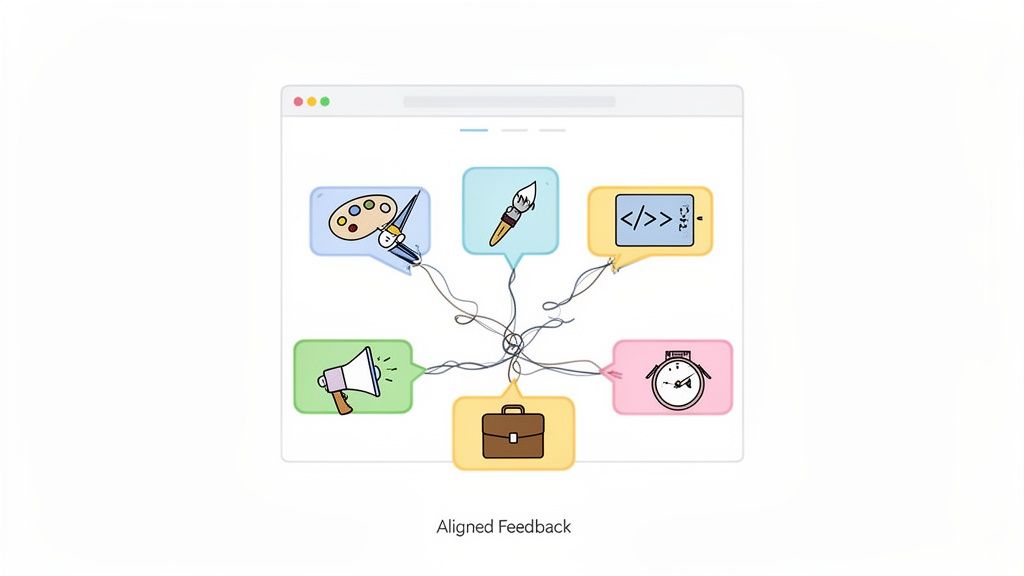
Effective feedback management is the cornerstone of this skill. Without a structured process, feedback becomes noise, leading to missed requirements, endless revision cycles, and frustrated teams. Centralizing feedback into a single source of truth prevents crucial insights from getting lost in emails, Slack threads, or meeting notes. This alignment is vital for building the right product efficiently.
How to Implement This Skill
Establish Clear Protocols: Before a project kicks off, define how, where, and when feedback will be collected and reviewed. Create a simple feedback template to ensure submissions are consistent and actionable.
Use Visual Feedback Tools: Reduce ambiguity by using tools like Beep that allow stakeholders to leave contextual comments directly on web prototypes, designs, or live sites. This links feedback directly to the specific element in question.
Organize and Prioritize: Use a system, such as a Kanban board in Beep or a dedicated project management tool, to track each piece of feedback from submission to resolution. This provides transparency and ensures nothing falls through the cracks.
Automate Communication: Integrate your feedback platform with tools like Slack or Zapier. This ensures real-time notifications are sent to the relevant team members, speeding up the entire feedback loop.
Key Insight: The goal isn't just to collect feedback, but to transform it into a structured, actionable, and transparent part of the development process. Centralized, visual feedback eliminates guesswork and aligns the entire team around a shared understanding.
Mastering this skill ensures that every stakeholder feels heard and valued, fostering a collaborative environment where the best ideas can surface and be integrated into the product. To dive deeper into managing these crucial relationships, explore our practical guide to stakeholder management in projects.
2. Product Data Analysis & User Insights
Beyond communication, one of the most essential product manager skills required is the ability to transform raw data into a strategic roadmap. Product managers must be adept at collecting, analyzing, and interpreting both quantitative and qualitative user data. This skill bridges the gap between what users do (metrics) and why they do it (feedback), enabling decisions based on evidence rather than assumptions.

This competency involves understanding user behavior patterns, identifying pain points from engagement funnels, and extracting actionable themes from user feedback. A PM who can correlate a drop in a conversion metric with specific user comments on a confusing UI element is invaluable. This data-driven approach ensures that development resources are focused on solving real, validated customer problems.
How to Implement This Skill
Combine Quantitative & Qualitative Data: Don’t analyze metrics in a vacuum. Use a tool like Beep to collect direct contextual feedback on web pages and overlay those qualitative insights onto your quantitative analytics data. For example, if analytics show high drop-off on a checkout page, Beep comments can reveal the exact element causing confusion.
Create Centralized Insight Dashboards: Visualize feedback trends to make them accessible and understandable for the entire team. Use Beep’s Kanban board to categorize feedback by theme (e.g., "UI bug," "feature request") and track which issues are most prevalent over time.
Implement Early Feedback Loops: Collect data and user insights from the very beginning of the design cycle. Share early-stage mockups or prototypes and encourage stakeholders to leave feedback directly on the designs. This pre-development analysis prevents costly mistakes down the line.
Schedule Regular Data Reviews: Make data analysis a team ritual. Hold bi-weekly sessions to review key product metrics alongside recent user feedback, discuss findings, and decide on the next actions as a cross-functional group.
Key Insight: Data becomes powerful when it tells a story. The best product managers don't just report numbers; they synthesize quantitative metrics with qualitative user feedback to narrate the user's journey and pinpoint exactly where to improve.
3. Technical Literacy & Product Architecture Understanding
While product managers don't need to be coders, a strong degree of technical literacy is one of the most impactful product manager skills required for success. This skill involves understanding the core technology stack, system architecture, and technical constraints of your product. It enables PMs to have more credible and productive conversations with engineering teams, make informed decisions about feasibility, and grasp the long-term implications of feature development on scalability and technical debt.
This understanding bridges the gap between the product vision and its technical execution. For example, knowing how Beep’s integration architecture works allows a PM to realistically scope new connections with tools like Jira or Notion. It helps in evaluating trade-offs, such as balancing a quick setup process with the addition of feature-rich capabilities that might increase complexity. Without this literacy, a PM risks creating roadmaps that are unrealistic, inefficient, or technically unsound.
How to Implement This Skill
Engage with Engineering: Schedule regular, informal sessions with your tech lead to discuss the product’s architecture. Ask "how" and "why" questions about technical decisions to build your foundational knowledge.
Study Your Stack: Take the time to learn the basics of the technologies your product is built on. Understand what each component does and how they interact.
Review API Documentation: If your product integrates with third-party tools, read their API documentation. This provides direct insight into what is and isn't possible, helping you define more realistic integration features.
Shadow Technical Processes: Ask to sit in on code reviews or technical planning meetings. Listening to developers discuss problems and solutions is an invaluable way to absorb technical context and terminology.
Key Insight: Technical literacy isn't about writing code; it's about speaking the language of your engineering team. This shared understanding builds trust, reduces friction, and empowers you to advocate for product decisions that are both ambitious and technically viable.
By developing technical fluency, product managers can more effectively guide their products from concept to launch, ensuring that strategic goals are supported by a robust and scalable technical foundation. For more on bridging this gap, check out our insights on how developers can use feedback tools to improve collaboration.
4. User-Centric Design & UX Thinking
At the heart of every successful product is a deep understanding of its users. A core entry among product manager skills required is the ability to adopt a user-centric mindset, championing the user's needs, motivations, and pain points at every stage of development. This skill goes beyond simply listening to feature requests; it involves true empathy, where the PM acts as the user's advocate in every meeting, ensuring that decisions are driven by user outcomes, not internal assumptions.
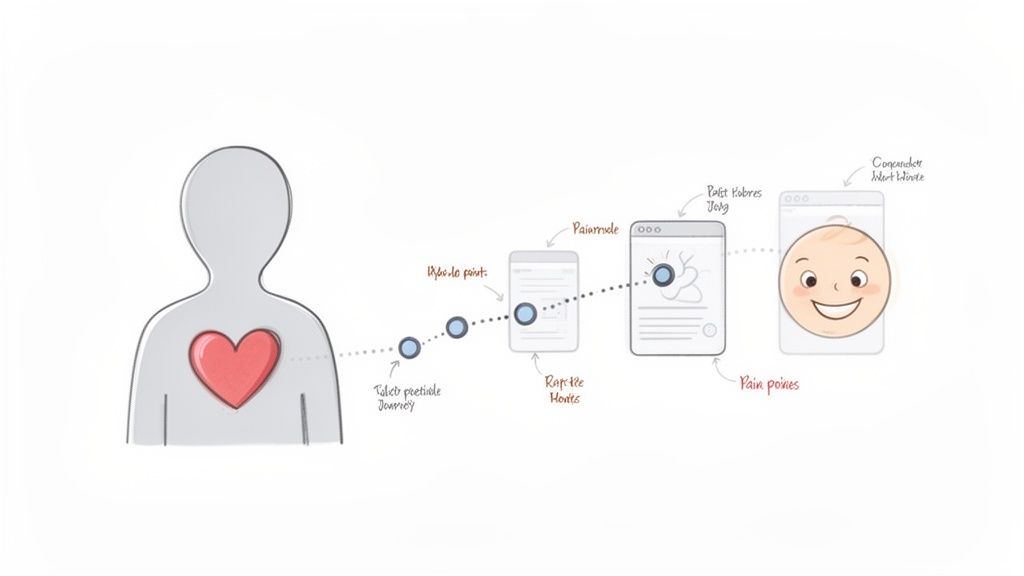
UX thinking is the practical application of this empathy. It means prioritizing usability, accessibility, and delight in the product experience. A product manager skilled in UX thinking can effectively collaborate with designers to translate user research into intuitive workflows and interfaces. They understand that a feature is only valuable if users can easily discover, understand, and use it to solve their problem.
How to Implement This Skill
Create Detailed User Personas: Develop personas based on real user research and data, not assumptions. These should guide product decisions and help the team maintain focus on the target audience.
Map the User Journey: Visualize the end-to-end user experience by creating journey maps. This helps identify key friction points, drop-offs, and opportunities for improvement in the user's workflow.
Gather Contextual UX Feedback: Use tools like Beep to collect visual feedback directly on prototypes or live designs. Analyzing user comments tied to specific UI elements provides clear, actionable insights into UX friction.
Advocate for Accessibility: Ensure the product is usable by people with diverse abilities. Champion inclusive design principles from the beginning, making it a core requirement rather than an afterthought.
Key Insight: Great products aren't just built with features; they're designed around user behaviors and needs. A user-centric approach transforms the development process from "what can we build?" to "what should we build to solve a real user problem?"
By embedding UX thinking into the product lifecycle, PMs ensure the team builds solutions that are not only functional but also intuitive and valuable to the end user. To explore this further, check out these 13 best UX design practices to elevate your product in 2025.
5. Roadmap Planning & Strategic Prioritization
Another of the most essential product manager skills required is the ability to create and maintain a clear, strategic product roadmap. This isn't just a list of features; it's a living document that communicates the "why" behind your product’s direction. A great product manager must balance long-term business goals, urgent user needs, and technical feasibility, making difficult trade-off decisions and systematically prioritizing what to build next.
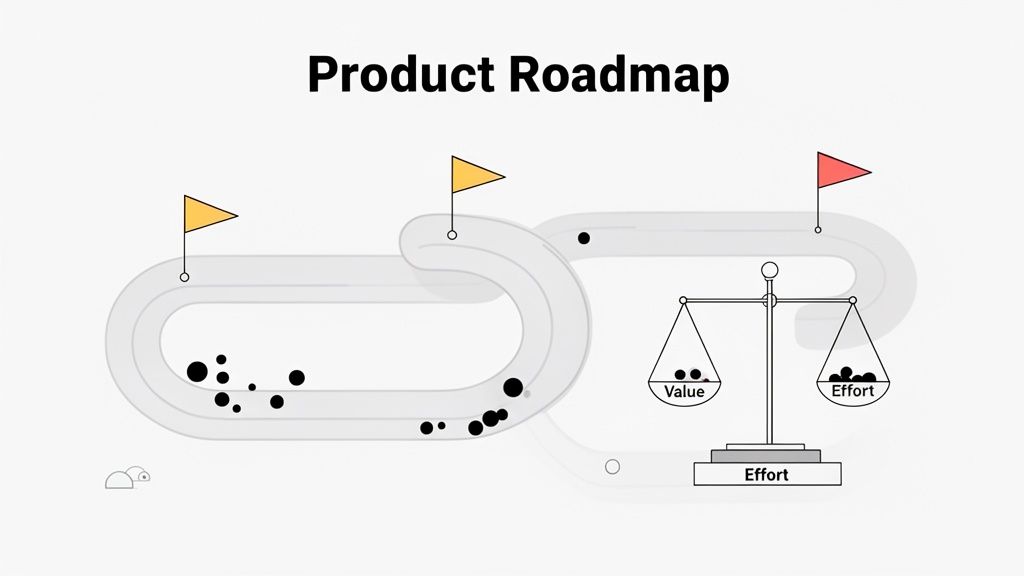
Strategic prioritization is the engine that drives an effective roadmap. It involves applying consistent frameworks to evaluate opportunities and having the discipline to say "no" to good ideas that don't align with the current strategy. Without this skill, teams can easily get pulled into building low-impact features or reacting to the loudest voice in the room, ultimately diluting the product's value and derailing its vision.
How to Implement This Skill
Establish Clear Prioritization Criteria: Define a framework (e.g., RICE, MoSCoW, or value vs. effort) that aligns directly with your core business objectives. Ensure every stakeholder understands how decisions are made.
Use Feedback to Validate Decisions: Leverage tools like Beep to quantify user feedback. Tracking feedback volume on a Kanban board can reveal high-impact bugs or feature requests, providing data-driven evidence to justify roadmap priorities.
Communicate the Roadmap and Rationale: Don’t just share the roadmap; explain the reasoning behind the priorities. This builds trust and ensures the entire organization understands the strategic direction and their role in it.
Build in Flexibility: A roadmap is a statement of intent, not a rigid plan. Regularly review it (e.g., quarterly) and be prepared to adjust based on new market data, competitive moves, or shifting user behavior.
Key Insight: A product roadmap's true power lies in its ability to align the entire organization around a shared vision. It transforms a collection of features into a strategic narrative, driven by data-backed prioritization rather than opinion.
Mastering roadmap planning ensures your team is always working on the most impactful initiatives. To help structure your thinking, check out our practical product manager roadmap template guide.
6. Cross-Functional Leadership & Influence
A defining characteristic of the best product manager skills required is the ability to lead without direct authority. Product managers are rarely the formal managers of engineers, designers, or marketers. Instead, they must inspire and influence these diverse, cross-functional teams to rally around a single product vision, motivating them through persuasion, shared purpose, and clear communication rather than hierarchical power.
This skill is about building consensus, navigating inevitable conflicts, and fostering an environment of psychological safety. When team members from different departments feel empowered to contribute their unique expertise and challenge ideas constructively, the product becomes exponentially stronger. It’s the product manager’s job to create that collaborative space and guide the collective effort toward a successful outcome.
How to Implement This Skill
Establish a Shared Vision: Clearly and repeatedly articulate the "why" behind the product and its features. When every team member understands the customer problem and the business goal, their individual contributions become more meaningful and aligned.
Create Transparency and Reduce Silos: Use centralized tools to ensure everyone has access to the same information. A shared feedback space, for instance, allows designers to see developer concerns and marketers to understand user feedback, breaking down departmental walls.
Facilitate, Don't Dictate: Lead meetings and discussions by asking questions and guiding conversations rather than issuing commands. Your role is to help the team arrive at the best solution together, leveraging the collective intelligence in the room.
Recognize Contributions Publicly: Acknowledge the hard work and valuable insights from all team members, regardless of their department. This builds morale and reinforces a culture of mutual respect and collaboration.
Key Insight: True cross-functional leadership isn't about having all the answers. It's about creating an environment where the best ideas can emerge from anyone, and then uniting the team to execute on that shared vision with conviction and clarity.
Mastering influence is essential for transforming a group of individual specialists into a cohesive, high-performing product team. By focusing on a shared purpose and transparent processes, a product manager can drive progress and deliver exceptional results.
7. Agile & Iterative Development Mindset
A crucial entry in our list of product manager skills required is the adoption of an agile and iterative mindset. This philosophy rejects the waterfall model of perfecting features in isolation. Instead, it prioritizes shipping minimum viable products (MVPs), gathering real-world user feedback, and continuously iterating based on data-driven insights. It demands a comfort with ambiguity and a growth-oriented perspective that treats all feedback as valuable learning opportunities, not just criticism.
This approach, popularized by figures like Jeff Bezos with his "Day 1" mentality, is about velocity and learning. It allows teams to validate assumptions quickly, reduce the risk of building the wrong product, and deliver value to customers sooner. By launching features in beta or using rapid feedback loops, product managers can de-risk major initiatives and ensure development efforts are always aligned with genuine user needs.
How to Implement This Skill
Define Clear Success Metrics: Before starting an iteration, establish what success looks like. Define key performance indicators (KPIs) that will determine if a feature is working or needs to be revisited.
Establish Iteration Cycles: Implement a disciplined rhythm, such as two-week sprints, to maintain momentum. This structure forces prioritization and ensures the team is consistently delivering and learning.
Use Feedback Tools for Rapid Cycles: Leverage platforms like Beep to accelerate the feedback loop. By getting contextual, visual feedback directly from users on a beta feature, you can iterate on UI/UX changes in days, not weeks.
Celebrate Learning: Foster a culture where learning from failed experiments is valued just as much as successful launches. This encourages smart risk-taking and innovation.
Communicate Learnings and Pivots: Keep stakeholders informed about what was learned during each cycle and explain any resulting changes in direction. This transparency builds trust and maintains alignment.
Key Insight: The agile mindset is not about being fast for the sake of speed; it's about accelerating the learning process. Each iteration is an experiment designed to answer a question, and every piece of user feedback is a data point that guides the product closer to what the market truly wants.
By embracing an agile and iterative approach, product managers can transform their development process into a continuous engine for discovery and value creation. To learn more about applying these principles, consider exploring Marty Cagan’s book, Inspired, which is a foundational text on modern product management.
8. Project & Delivery Management
While a product manager's primary focus is on the "what" and "why," understanding the "how" and "when" is a non-negotiable part of the job. This is where project and delivery management becomes one of the most practical product manager skills required. It involves managing timelines, allocating resources, and tracking dependencies to ensure that product features are delivered on schedule and within scope. This skill is the bridge between the product vision and its tangible execution.
A product manager who excels at delivery management can create realistic roadmaps, manage stakeholder expectations, and maintain momentum. They coordinate across engineering, design, and marketing to identify and remove blockers before they derail a release. While the product manager focuses on what to build, understanding the how is critical, and these often overlap with the core IT project manager responsibilities. Without this skill, even the best product strategy can fail due to poor execution.
How to Implement This Skill
Break Down Large Initiatives: Deconstruct complex projects into smaller, manageable milestones and tasks. This approach makes progress easier to track and helps the team celebrate small wins along the way.
Use Integrated Tooling: Maintain a single source of truth for project status. For example, using a Beep-Jira integration ensures that feedback resolution and development tasks are perfectly synced, eliminating manual updates and miscommunication.
Conduct Regular Retrospectives: Hold weekly or bi-weekly meetings to review what went well and what could be improved. This continuous feedback loop helps refine your delivery process over time.
Communicate Proactively: If delays are inevitable, communicate them early and transparently to all stakeholders. Provide a clear explanation for the delay and a revised timeline to maintain trust and manage expectations.
Key Insight: Effective delivery management isn't about being a traditional project manager. It's about instilling a rhythm of execution and transparency that empowers the team to build the right thing, the right way, and on time.
9. Market & Competitive Intelligence
A crucial entry among the top product manager skills required is the ability to deeply understand the market landscape. This involves more than just knowing who your competitors are; it's about continuously analyzing their strategies, identifying emerging industry trends, and anticipating shifts in customer needs. Product managers use this intelligence to inform product differentiation, guide strategic feature prioritization, and maintain a competitive edge.
Without this skill, a product risks becoming irrelevant, blindsided by market shifts or outmaneuvered by competitors. For example, understanding that the rise of remote work heavily favors asynchronous collaboration tools helps a company like Beep position its visual feedback platform as a solution for distributed teams. This strategic awareness ensures the product roadmap is not just reactive but proactively aligned with market opportunities.
How to Implement This Skill
Schedule Regular Analysis: Dedicate time each quarter to conduct a formal competitive analysis. Create and maintain competitive comparison matrices that track features, pricing, and market positioning.
Stay Informed Continuously: Follow key industry publications, influential blogs, and thought leaders on social media. Set up alerts for competitor announcements and product updates to stay current.
Talk to Your Customers: Conduct regular customer interviews to understand why they chose your product over alternatives. Use their insights to validate your assumptions about your competitive advantages and weaknesses.
Monitor Industry Trends: Recognize broader shifts that affect your product. For instance, knowing that integration capability with tools like Slack, Jira, or Notion is a key market expectation helps prioritize API development.
Key Insight: Market intelligence isn't a one-time research project; it's a continuous discipline. The goal is to transform market data and competitive insights into a strategic compass that guides every product decision, from high-level vision to individual feature implementation.
By embedding this continuous learning process into your workflow, you ensure your product not only meets current customer needs but is also positioned to win in the future.
10. Communication, Storytelling & Evangelism
A truly impactful product manager skills required set includes the ability to craft and communicate compelling narratives. Product managers must go beyond data and feature lists to articulate a product's vision, strategic value, and market opportunity through powerful storytelling. This involves weaving complex technical decisions and customer problems into a clear, inspiring story that resonates emotionally and intellectually with engineers, executives, and customers alike.
Effective evangelism turns stakeholders into advocates and teams into believers. A great story can justify a difficult roadmap decision, secure executive buy-in for a risky initiative, or inspire an engineering team to push through a challenging sprint. It transforms a product from a collection of features into a solution that solves a real, human problem, making its value tangible and unforgettable.
How to Implement This Skill
Develop a Core Narrative: Ground your product’s story in the customer’s problem. For instance, instead of just listing features, frame Beep as a solution that eliminates video call fatigue and saves teams hundreds of hours by replacing tedious meetings with quick, asynchronous visual feedback.
Use Customer Success Stories: Illustrate impact with real-world examples. Create compelling before-and-after case studies showing how teams struggled with chaotic feedback before using a tool like Beep and how they achieved streamlined collaboration afterward.
Adapt Your Message: Tailor your story for your audience. For engineers, focus on the technical challenge and customer impact. For executives, emphasize the market opportunity and strategic alignment. For customers, highlight the direct benefits and ease of use.
Practice and Refine: Rehearse your presentations and solicit feedback from peers. A well-delivered story is as important as the content itself. Use visual aids and data to complement your narrative, not replace it.
Key Insight: People don't buy what you do; they buy why you do it. A powerful narrative connects the 'what' (the product features) to the 'why' (the core problem you solve), transforming passive listeners into passionate supporters and evangelists for your vision.
Top 10 Product Manager Skills Comparison
Item | 🔄 Implementation Complexity | ⚡ Resource Requirements | 📊 Expected Outcomes | 💡 Ideal Use Cases | ⭐ Key Advantages |
|---|---|---|---|---|---|
Stakeholder Communication & Feedback Management | Medium — establish protocols and tooling | Medium — collaboration tools, facilitator time | Reduced miscommunication; faster decisions | Design reviews, cross-team feedback, async collaboration | Clear audit trails; aligned stakeholders; less scope creep |
Product Data Analysis & User Insights | Medium–High — data collection, analysis pipelines | High — analytics tools, data access, analyst time | Evidence-based decisions; validated hypotheses | Growth optimization, feature validation, roadmap evidence | Prioritized roadmap; risk reduction; measurable impact |
Technical Literacy & Product Architecture Understanding | High — learning constraints and trade-offs | Medium — engineering time, access to docs, training | Fewer surprises; realistic estimates; feasible plans | Integration projects, scalability planning, architecture choices | Better engineering alignment; reduced technical debt |
User-Centric Design & UX Thinking | Medium — research and iterative testing cycles | Medium — user research, prototypes, testing tools | Higher satisfaction; lower churn; improved usability | Onboarding flows, usability fixes, accessibility work | Increased adoption; fewer late-stage redesigns; stronger retention |
Roadmap Planning & Strategic Prioritization | Medium–High — framework application and stakeholder negotiation | Medium — cross-functional input, prioritization tools | Focused roadmap; aligned objectives; measurable milestones | Long-term planning, release sequencing, strategic pivots | Maximized impact; transparent trade-offs; accountability |
Cross-Functional Leadership & Influence | High — consensus building across teams | Medium — time, EI, communication channels | Faster alignment; cohesive execution; engaged teams | Org-wide initiatives, cross-team launches, conflict resolution | Stronger collaboration; reduced silos; shared ownership |
Agile & Iterative Development Mindset | Low–Medium — cultural shift and discipline | Low–Medium — tooling, iteration cadence, metrics | Faster learning; validated features; lower risk | MVP launches, rapid experiments, continuous delivery | Rapid validation; reduced waste; greater adaptability |
Project & Delivery Management | Medium — planning, tracking, dependency management | Medium — PM tools, coordination, contingency buffers | Predictable delivery; improved forecasting; fewer blockers | Time-bound releases, complex dependency projects | On-time delivery; visibility; optimized resource use |
Market & Competitive Intelligence | Medium — ongoing research and monitoring | Medium — research tools, analyst time, customer interviews | Informed positioning; proactive feature bets; market awareness | New market entry, differentiation, strategic planning | Early opportunity ID; fewer strategic surprises; better positioning |
Communication, Storytelling & Evangelism | Low–Medium — crafting and tailoring narratives | Low — presentation assets, practice time, content | Stronger buy-in; clearer vision; improved stakeholder alignment | Investor pitches, internal visioning, product launches | Persuasive alignment; simplifies complexity; boosts engagement |
Integrating Skills into a Cohesive Product Practice
Mastering the full spectrum of product manager skills required for success is not a one-time achievement; it is a continuous journey of integration and refinement. The ten core competencies we have explored, from Stakeholder Communication to Storytelling & Evangelism, are not isolated checklist items. Instead, they are deeply interconnected threads that, when woven together, form the fabric of an elite product practice. The most effective product managers understand this synergy intuitively. They don't just analyze data; they use it to tell a compelling story that aligns stakeholders and inspires the engineering team. They don't just create roadmaps; they build them on a foundation of deep user empathy and technical feasibility.
The journey from a good product manager to a great one lies in transforming this list of skills into a fluid, adaptable, and cohesive professional identity. It's about recognizing that every interaction, every decision, and every artifact you create is an opportunity to apply and hone multiple skills at once. Your ability to lead without authority, for instance, is directly amplified by your technical literacy and your capacity for clear, empathetic communication. Similarly, your strategic prioritization becomes far more powerful when informed by robust market intelligence and quantitative user insights.
From Theory to Practice: Your Actionable Next Steps
To truly internalize these concepts and make them a part of your daily workflow, you must move from passive learning to active application. The path forward is about deliberate practice and creating systems for continuous improvement.
1. Conduct a Personal Skills Audit: Start by honestly assessing your current capabilities against the ten skills outlined. A simple self-rating system can be highly effective.
Create a matrix: List the ten skills and rate yourself on a scale of 1-5 (1 = Novice, 5 = Expert).
Gather evidence: For each rating, jot down a specific example from a recent project that justifies your score. This prevents over- or under-confidence.
Seek external feedback: Share your self-assessment with a trusted manager or mentor. Ask them for their candid perspective on your strengths and areas for growth. This 360-degree view is invaluable.
2. Adopt the 'T-Shaped' PM Model: You don't need to be a world-class expert in all ten areas simultaneously. The goal is to become a 'T-shaped' professional: possessing broad knowledge across all domains (the horizontal bar of the 'T') while developing deep, spikey expertise in two or three key areas (the vertical stem).
Identify your "spike": Which skills align with your natural talents or the specific needs of your current role? Are you a data-driven PM, a user-empathy PM, or a technical PM? Double down on making these your superpowers.
Shore up your foundation: For the areas where you rated yourself lower, create a specific learning plan. This could involve reading a recommended book, taking an online course, or shadowing a colleague who excels in that skill.
3. Embrace an Iterative Improvement Loop: Just as we build products iteratively, we must build our skills iteratively. Create a personal development cycle.
Set quarterly goals: Pick one or two skills to focus on each quarter.
Define success metrics: How will you know you've improved? Examples could include: "Reduce the time it takes to get roadmap alignment by 20%" (testing Stakeholder Management) or "Increase the adoption of a new feature by 15% through better user story definition" (testing User-Centric Design).
Reflect and adjust: At the end of the quarter, review your progress, celebrate your wins, and identify the next skill to focus on.
The True Impact of Integrated Skills
Ultimately, mastering the diverse product manager skills required in today's market is about more than just career advancement. It's about becoming the central force that transforms a brilliant idea into a tangible, valuable product that solves real-world problems. It's about earning the trust of your team, the confidence of your leadership, and the loyalty of your users. By viewing these skills not as a static list but as a dynamic, interconnected system, you build the resilience and adaptability needed to navigate the complexities of product development. You become the product leader who doesn't just manage a backlog but who inspires a shared vision and drives meaningful outcomes.
Ready to master the art of stakeholder communication and feedback management? Beep provides a centralized, visual platform to gather, organize, and act on feedback from users and internal teams directly on your live product or staging environments. Streamline your workflow and demonstrate your collaborative prowess by trying Beep today.
The emphasis on balancing strategic thinking, technical fluency, and empathy feels especially relevant for PMs in 2026. I’m also exploring tools that help teams ship faster—check out https://pencilai.site/pencil-ai-vs-chatgpt
Resolving verification issues is much easier when everything is prepared beforehand instead of searching for documents while talking to support. With account details already collected, AutoAuth customer service number naturally fit into the research process and provided useful insight into previous customer experiences. That extra knowledge helped shape a much clearer request, making the entire interaction more productive and reducing unnecessary follow-up communication.
I'm currently working toward becoming a PM and really appreciate how it breaks down each competency with actionable tips. The section on stakeholder communication resonates especially well, managing feedback from engineers, designers, and executives can feel overwhelming without a structured process. I was trying to get help with a software subscription last week and had to find the cleverbridge customer service phone number because their billing portal wasn't working. Love the emphasis on combining quantitative data with qualitative user insights, that's something I want to practice more.